Detached, semi-detached, terrace duplex and BQ explained
In Nigeria a duplex is a house on two floors. Detached stands alone, semi-detached shares one wall, a terrace duplex is one of a row, and a BQ is a small separate unit.
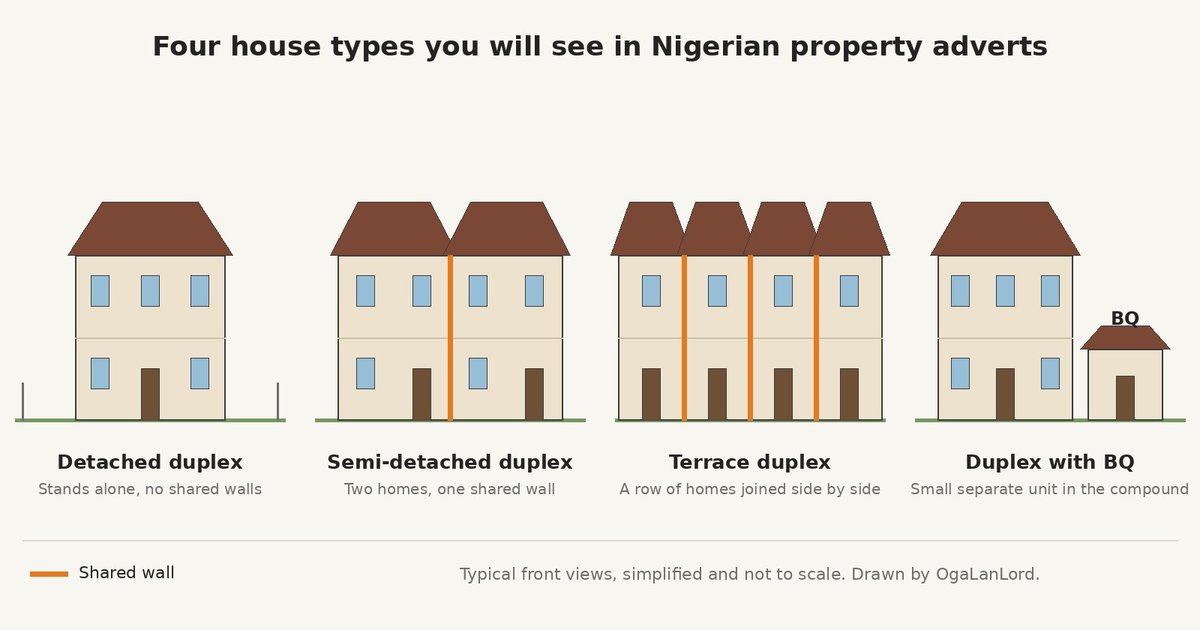
In Nigeria, a duplex is a house built on two floors for one household. A detached duplex stands on its own with no shared walls. A semi-detached duplex is one of two homes joined by a single shared wall. The terrace duplex meaning is simple once you see it: one home in a row of three or more, joined side by side. A BQ, or boys' quarters, is a small separate unit in the same compound as the main house.
These words come up in almost every advert for a house, often all at once, as in "4 bedroom semi-detached duplex with BQ". Below is what each one means, a simple drawing, and what each type means for privacy, noise, repairs and day-to-day living, whether you plan to buy or rent.
What "duplex" means in Nigeria
In Nigerian adverts, "duplex" means one home with rooms on two levels, usually the parlour, kitchen and a guest room downstairs and the bedrooms upstairs. In the United States the same word often means one building split into two separate homes, so foreign websites can confuse you. Here, think "two-storey house".
A house on one floor is a bungalow. A building with several separate flats stacked on top of each other is a block of flats. A maisonette is a home on two levels inside a larger building, so it looks like a flat from outside but feels like a small duplex inside.
Detached duplex
A detached duplex is a two-storey house that doesn't touch any other building. It sits on its own plot, usually with space on all four sides, a fence and its own gate.
- Privacy: you share no walls, so a neighbour's noise, leaks or renovation work don't come through to you.
- Repairs: the roof, walls and compound are yours to fix, without needing anyone else to agree.
- Space: there is usually room for parking, a borehole, an overhead tank and the generator away from the bedrooms.
- Cost of upkeep: more wall, roof and compound to look after, and security for the whole fence line is on you.
Some adverts say "fully detached" to make the point that nothing is joined to the house, not even a BQ or a garage.
Semi-detached duplex
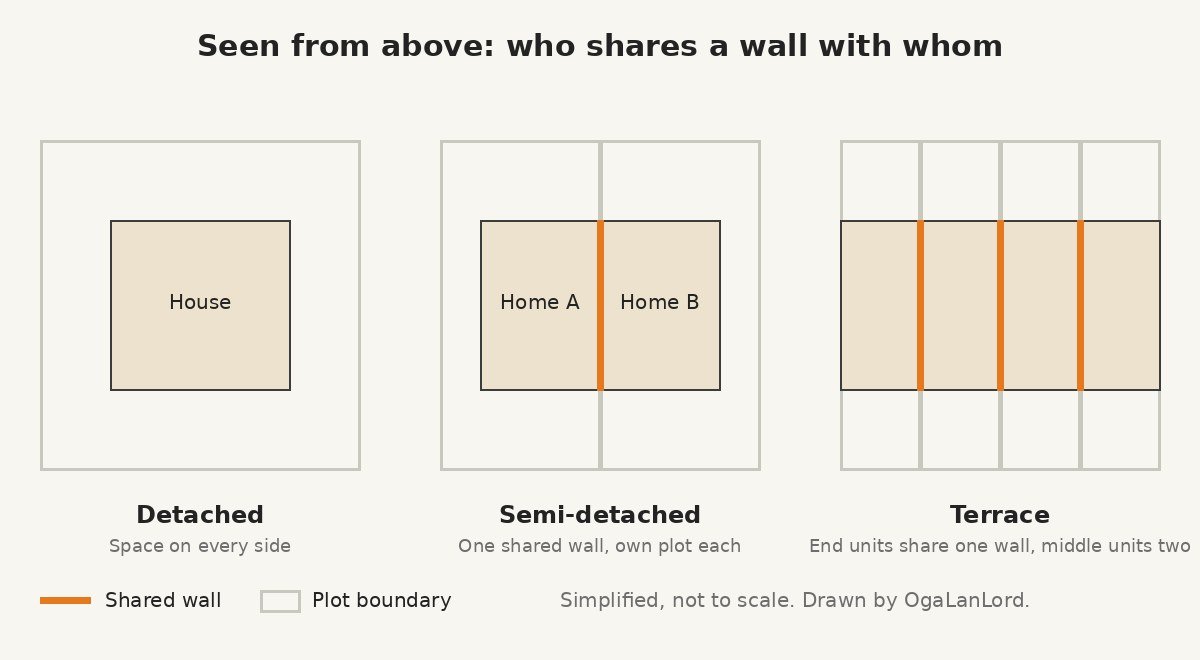
A semi-detached duplex is one of a pair of two-storey homes built as mirror images and joined by one shared wall. Each home has its own front door, and often its own part of the compound, but the two share that middle wall and sometimes a roof line.
- Privacy: good on three sides. Sound can carry through the shared wall, especially from a staircase or a generator placed against it.
- Repairs: a leak or crack along the shared wall or roof may need both owners to agree and share the work.
- Compound: ask whether the gate, parking, borehole and septic tank are shared with the other half, and who pays for them.
Terrace duplex meaning
A terrace duplex is one of three or more two-storey homes built in a straight row, each joined to the next. An end unit shares one wall. A middle unit shares two, one on each side. Developers often build terraces in estates, where one plot of land holds several homes.
What it means in practice:
- Light and air: middle units have windows only at the front and back, so check how bright and airy the rooms are, especially the kitchen.
- Noise: you will hear more from neighbours than in a detached house. Visit in the evening if you can.
- Estate rules: terraces in estates usually come with a residents' association, gate rules and a service charge for security, waste and shared power or water. Ask for the rules and the charge in writing.
- Changes to the house: extending, adding a floor or changing the outside may need the estate's approval, because your house is part of a row.
If you are buying in a terrace, ask what document you will get for your own unit and have your own lawyer check it before you pay. Read the paperwork for a single unit as carefully as you would for a whole house.
What is a BQ?
BQ is short for boys' quarters, an old term for staff housing. Today it means a small separate building in the same compound as the main house, usually at the back or to one side, with its own door. It may be one room, a self contain or a room and parlour, so ask which.
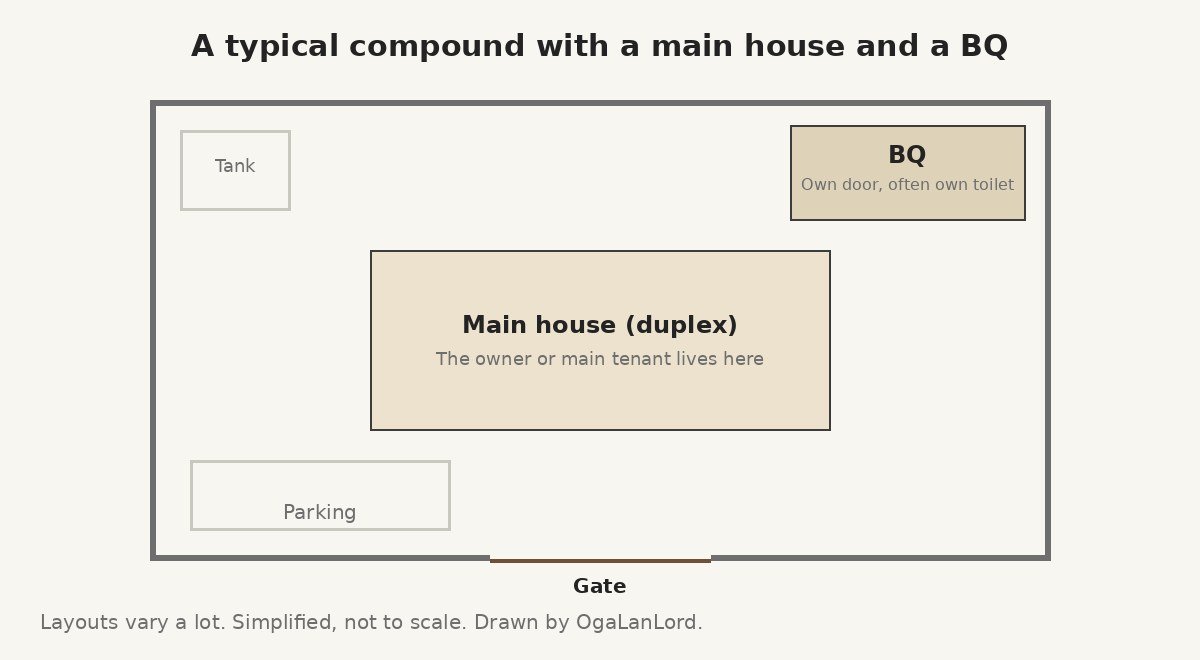
People use a BQ for a driver, a housekeeper, a relative, older children or guests, or as a home office. Some owners rent it out. When an advert says "with BQ", the BQ normally comes with the house, but don't assume it.
- Is the BQ included in the rent or the sale, or is someone else living in it?
- Does it have its own toilet, bathroom and kitchen, or does it rely on the main house?
- Is it on its own meter? If not, ask how the light bill is shared.
- Can it be rented out? In some estates and tenancy agreements, letting the BQ to another person isn't allowed.
Which type suits you?
- You want quiet and full control: a detached duplex.
- You want a house with a compound but a smaller one to look after: a semi-detached duplex.
- You like estate living with shared security and don't mind neighbours close by: a terrace duplex, ideally an end unit.
- You need a separate space for staff, family or work: any of the above "with BQ".
For smaller homes, our guide to self contain, mini flat and room and parlour explains those terms the same way.
Questions to ask before you inspect
Send these to the agent or owner before you travel to see the house.
- Which walls are shared, and with how many neighbours?
- What is shared in the compound: the gate, parking, borehole, overhead tank, generator or septic tank?
- Is there a service charge, what does it cover, and can you see the estate rules?
- Is the BQ part of the deal, empty, and on its own meter?
- Who fixes the roof and shared walls if something leaks?
Ask for a short video on WhatsApp first, then inspect in person and check that the house matches the advert. A "detached duplex" that turns out to share a wall is worth knowing about before any money changes hands.
See what is listed
Browse houses and other property listed on OgaLanLord and use these terms to read each advert properly. Every listing is reviewed by our team before it goes live, including a call to the owner or agent.
If you own or manage a duplex, a BQ or any other home, you can list your property on OgaLanLord. Say clearly whether it is detached, semi-detached or terrace, and whether the BQ is included, so buyers and tenants know what they are coming to see.
Drawings: house type and compound illustrations made by OgaLanLord for this post.